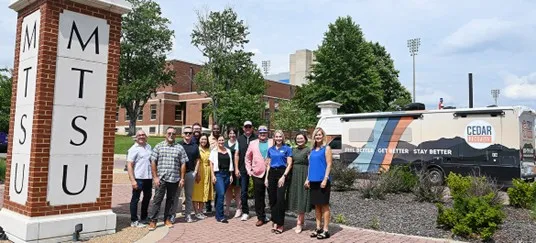
Middle Tennessee State University’s (MTSU’s) Center for Health and Human Services and Cedar Recovery have partnered over the past two years to establish medication-assisted treatment (MAT) access points in six rural Tennessee counties through a Health Resources and Services Administration (HRSA) Rural Communities Opioid Response Program (RCORP) MAT Access grant. The initiative aims to reduce morbidity and mortality associated with substance use disorders. Cedar Recovery specializes in treating opioid use disorder with medications such as buprenorphine and naltrexone. Cedar currently operates 12 Tennessee and Virginia locations and a robust telemedicine platform that serves more than 4,000 patients each month. While Cedar Recovery provides direct services for the MAT Access grant, MTSU’s Center for Health and Human Services provides coordination and support throughout the life of the project.
We are working to expand patient treatment services and strengthen the MAT workforce in six rural communities through professional development opportunities and targeted support. These efforts include operating Tennessee’s first mobile unit dedicated solely to MAT, serving Franklin, Lawrence, Marshall, Giles, and Hickman counties. A new on-site clinic in Claiborne County is also now operational. In addition, we continue building and strengthening local drug prevention and treatment coalitions in the identified communities and recently launched the Monthly Middle Tennessee MAT Mobile Message newsletter to keep residents informed.
Along with serving the general public, jail-based services are offered in Giles County to provide treatment for incarcerated individuals so that when they re-enter society, they are better equipped to continue their recovery, access needed services and successfully reintegrate into their communities. These efforts help ensure continuity of care during a critical transition period and support individuals in developing healthy, stable routines upon release. By reinforcing connections between correctional facilities and community providers, we aim to improve long-term outcomes for both the individuals served and the communities to which they return.
The contents in this TA resource are those of the author(s) alone and do not necessarily represent the official views of, nor an endorsement by, JBS International, HRSA, HHS, or the U.S. Government.
